European and Ukrainian astronomers chart a path for recovery at EAS 2026
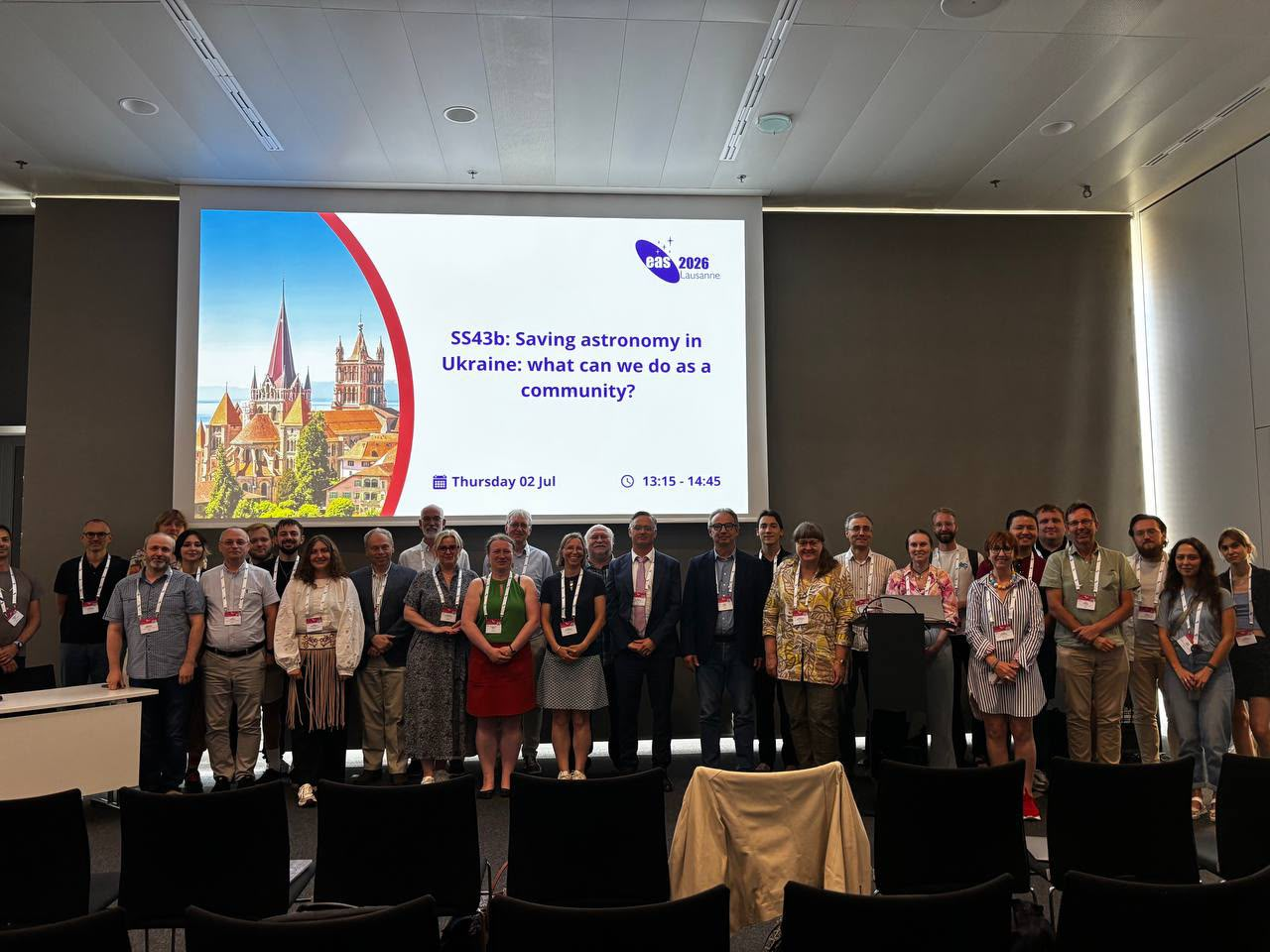
At the European Astronomical Society Annual Meeting (EAS 2026) in Lausanne, the Ukrainian astronomical community and colleagues from across Europe met during the special session "Saving astronomy in Ukraine: what can we do as a community?" to discuss the future of Ukrainian astronomy and identify concrete steps towards its recovery and long-term integration into the European Research Area.
The session, organised by Iurii Sushch (CIEMAT / Ivan Franko National University of Lviv) together with Kateryna Frantseva (University of Groningen) and Pavlo Plotko (German Centre for Astrophysics, DZA), brought together representatives of the Ukrainian Astronomical Association (UAA), leading Ukrainian research institutions, alongside leaders of major European research infrastructures and scientific organisations.
A central element of the session was the presentation of the Recovery Plan for Ukrainian Astronomy, delivered by Ihor Lukianyk (Taras Shevchenko National University of Kyiv). The roadmap, developed by the Ukrainian astronomical community over the past year, outlines a long-term vision for rebuilding the field around four strategic priorities: strengthening human capital and international scientific networks, restoring and modernising research infrastructure, fostering innovation and economic development, and advancing education and public engagement. Rather than simply reconstructing what has been lost, the plan proposes using recovery as an opportunity to build a more modern, internationally connected and resilient astronomical ecosystem that is fully integrated into the European Research Area.
The invited speakers demonstrated that many of the elements needed to support this vision already exist across Europe. Michiel van Haarlem, Director of LOFAR ERIC, reviewed the long-standing contribution of Ukrainian radio astronomy to Europe and outlined prospects for reconnecting Ukrainian facilities with the LOFAR network following their recovery. Stuart McMuldroch, Director General of the Cherenkov Telescope Array Observatory (CTAO), presented opportunities for strengthening Ukraine's participation in CTAO through its ERIC framework. Martin Giard introduced the Astronet Science Vision and Infrastructure Roadmap 2023 to 2035, highlighting its strong alignment with the priorities identified by the Ukrainian recovery plan. Gražina Tautvaišienė presented opportunities available through the Europlanet Telescope Network, the OPTICON Alliance and ESO's Open Skies policy, while Jakub Szlachetko outlined complementary European initiatives supporting Ukrainian research infrastructures, including EURIZON, Light for Ukraine, RIFF and FORWARD. Together, the presentations illustrated that the recovery of Ukrainian astronomy is closely connected to broader European efforts to strengthen research infrastructures, scientific collaboration and researcher mobility.
The second half of the session was devoted to a structured discussion around the four thematic directions of the Recovery Plan. Participants from Ukrainian and European institutions discussed practical mechanisms for implementing the roadmap, including long-term institutional partnerships, integration into European research infrastructures, support for early-career researchers and students, development of shared data infrastructures, and new educational initiatives. Rather than presenting a finished document, the Ukrainian community explicitly invited comments, criticism and new ideas from European colleagues, with the aim of refining the Recovery Plan into a shared strategic vision.
One of the main outcomes of the discussion was the recognition that cooperation should continue beyond the conference. Participants agreed to move towards establishing a standing advisory board composed of highly recognised scientists from both the Ukrainian and European astronomical communities. The board is expected to provide strategic advice on the further development of the Recovery Plan, serve as a permanent point of contact between the communities, and advocate for Ukrainian astronomy within European scientific organisations and funding frameworks. The Ukrainian Astronomical Association will coordinate the initiative and facilitate the continued dialogue.
The Ukrainian astronomical community concluded the session by expressing its appreciation for the strong support already demonstrated by European colleagues and by inviting further feedback on the Recovery Plan in the coming months. The organisers hope that the discussions initiated in Lausanne will develop into lasting partnerships that will help ensure not only the recovery of Ukrainian astronomy, but its full participation in the future of European astronomical research.
Session programme: SS43a (Thursday morning), SS43b (Thursday lunch).