Why recovery is needed
The impact of the war
Russia's full-scale invasion in February 2022 caused unprecedented losses for Ukrainian astronomy: researchers displaced or under arms, observatories occupied, damaged or cut off, budgets and student numbers falling. This page summarises what happened, drawing on the community's own Recovery Plan and independent reporting. And it records the other side of the story: a field that has not stopped working.
This page is under construction and will be expanded in the coming weeks.
People: losses and displacement
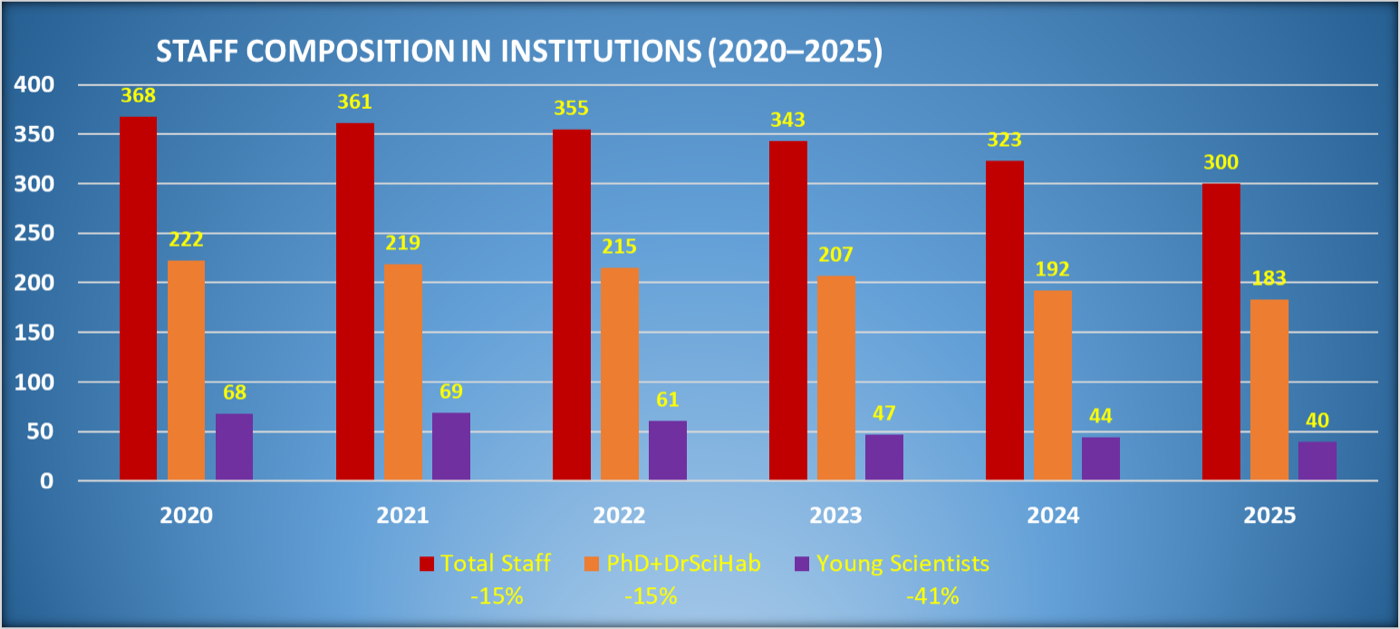
According to the Ukrainian Astronomical Association, the total number of scientific personnel in astronomical institutions has decreased by 12 to 44 percent, depending on the institution. The situation is most critical for young scientists, whose share has fallen by 41 percent compared to the pre-war period. At the Taras Shevchenko National University of Kyiv, four observatory staff members serve in the Armed Forces of Ukraine. As of 2025, up to 20 percent of researchers from Kharkiv remain abroad, and half of the students are also in forced displacement.
At the Institute of Radio Astronomy in Kharkiv, despite a general staff reduction of 12.3 percent, 94.4 percent of the scientists were retained, a deliberate choice to preserve intellectual capacity above all else.
Infrastructure: occupation, destruction, damage
The observational infrastructure of the Kharkiv region suffered the greatest losses. The S. Ya. Braude Observatory, home of the UTR-2 radio telescope, was occupied for six months in 2022. Of the 17 buildings on the observatory grounds, 16 suffered significant damage; servers and computer equipment were looted, and several dozen of the 2,040 UTR-2 antennas were damaged. Independent reporting describes mined service tunnels, a destroyed control-centre roof and stripped electronics; after a year of repairs and demining, the observatory returned to taking data in October 2023.
The Chuhuiv observing station of Karazin University found itself in the combat zone: the CCD cameras of the AZT-8 and Baker-Schmidt telescopes were destroyed, and five television cameras of the meteor patrol were stolen.
In June 2025, a Russian strike on Kyiv damaged buildings of the Main Astronomical Observatory of the NAS of Ukraine, blowing out windows in the main building and damaging the building of the ATsU-5 horizontal solar telescope.
In early 2026, the blast wave from a drone damaged the buildings of the Astronomical Observatory in Odesa's Shevchenko Park: 84 windows were blown out or damaged, the roof of the Space Research Division building was destroyed, and the 19th-century main building, an architectural monument, was hit, including the dome of the 1886 Cook telescope and the pavilion of the Repsold Meridian Circle. The Mayaky observing station, which preserves Odesa's famous collection of astrographic plates, has been mothballed indefinitely because it lies in a high-risk zone.
In Lviv, the observational base of Lviv Polytechnic was damaged by power outages and window damage from a nearby missile strike. The high-altitude Terskol observatory of ICAMER, with its 2-metre Zeiss telescope, is no longer accessible to Ukraine.
Funding under martial law
All institutions report a critical reduction in baseline funding. At the Kyiv university observatory, budget funding fell from UAH 9.15 million in 2020 to UAH 5.5 million in 2024, and National Heritage object funding was cut from UAH 0.49 million to UAH 0.15 million. Karazin University saw similar cuts. The Main Astronomical Observatory records a salary fund deficit of up to 50 percent. Institutions fill the gaps with competitive grants from the National Research Foundation of Ukraine and international programmes such as EURIZON, ALLEA, PAUSE and DFG.
Energy instability
Regular strikes on the energy grid have forced institutions into autonomous power supply: Kharkiv University installed a 21.6 kW solar power station received as a donation from the Exil-VHS consortium, the Lviv and Lviv Polytechnic observatories run on generators, and the Kyiv university laboratories on uninterruptible power supplies. At the Braude Observatory, a small solar power station keeps the GURT telescope taking data.
Education in wartime
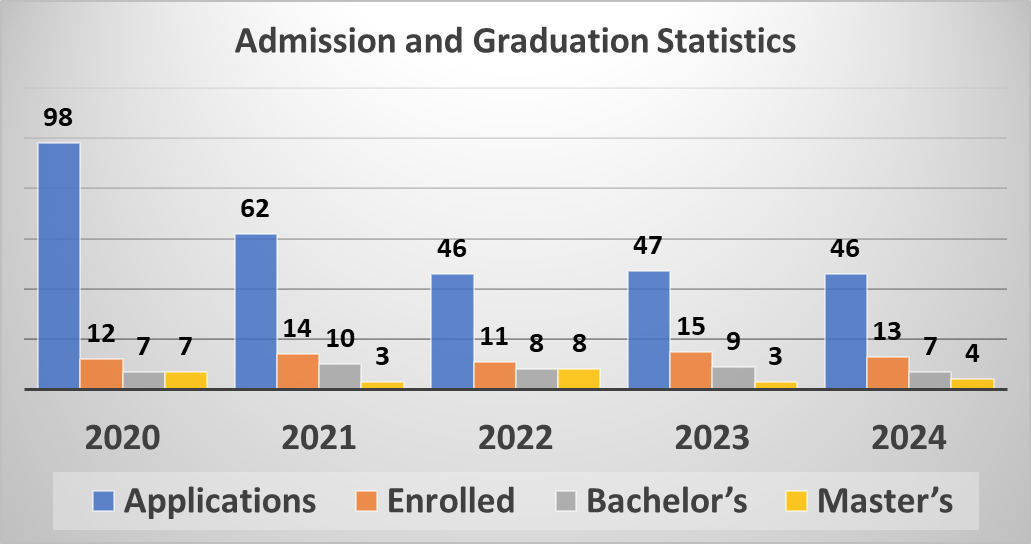
Part of the classes in Kyiv and Lviv took place in bomb shelters or online. Student enrolment is a worrying trend: the number of applicants to astronomical specialisations at the Taras Shevchenko National University of Kyiv fell from 98 in 2020 to 46 in 2024. There are also signs of resilience: Lviv University's new "Astrophysics and Space Physics" programme opened with 16 students, the highest first intake at its Faculty of Physics, and Lviv Polytechnic opened new Earth-science programmes in 2024 and 2025.
And yet: the field keeps working
Between 2020 and 2025, Ukrainian astronomers published over 800 scientific papers, more than 250 of them indexed in Scopus and Web of Science, including highly cited work within the CTAO and LISA consortia. Ukrainian institutions remain members of CTAO, LISA, LOFAR, NenuFAR, EUROPLANET, ChETEC-INFRA and EISCAT, and Ukrainian scientists hold elected positions in the International Astronomical Union and the European Astronomical Society. This resilience is the foundation on which the Recovery Plan builds.